

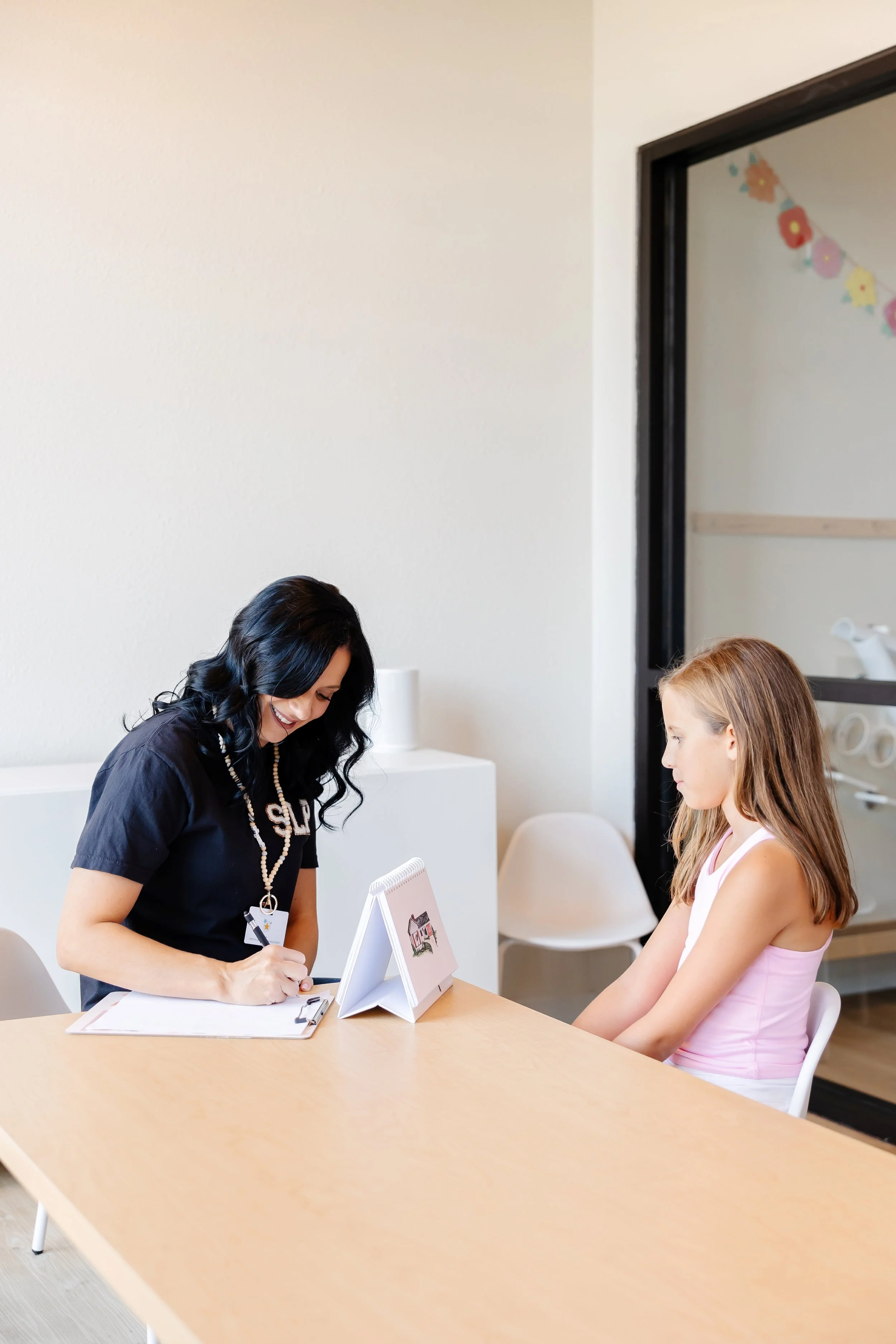
Pediatric Speech & Language Evaluations
Understand your child’s communication skills, identify areas for support, and know what to do next.
We understand that navigating the healthcare system is often stressful and confusing. We partner with families to make the process easier by providing clear steps, honest recommendations, and open communication.
Here's what you can expect before, during, and after a speech evaluation.
Get Started By Speaking With a Canopy Speech-Language Pathologist
Whether you're just beginning the process or already have a referral, a conversation with a Canopy speech therapist is the best place to begin. Our complimentary phone consultations give us an opportunity to:
Answer your questions.
Share information regarding developmental milestones.
Provide practical strategies for you to use at home (therapy can start before you even enter the door).
Offer honest recommendations on whether an evaluation is right for your child.
Click the button below to complete our contact form and schedule your complimentary 15-minute phone consultation.
While every child develops at their own pace, our speech therapists recommend exploring a speech and language evaluation when a child:
Signs a Speech & Language Evaluation May Be Beneficial
❋ Isn't talking as much as other children their age.
❋ Has difficulty expressing their thoughts, wants, or needs
❋ Is difficult for others to understand.
❋ Struggles with understanding or following directions.
❋ Has trouble interacting or communicating with others
❋ Stutters or has difficulty speaking smoothly.
Clarity
understanding
reassurance
direction
hope
action plan
The Evaluation Process
If a speech evaluation is recommended, we'll help you schedule your appointment and explain how to get a referral from your pediatrician.
Step 1: Your Child's Story

Before your visit, you'll complete a developmental history form so we can learn more about your child's developmental milestones, how they communicate, and your goals for speech therapy.
Step 2: Play Based Observation

We make the evaluation fun and engaging by following your child's lead while observing:
How they interact.
Their understanding of directions.
Their speech sounds.
Their grammar, syntax, and vocabulary.
Step 3: Assessment

Using standardized assessments, games, pictures, and other age-appropriate activities, we'll evaluate:
Skills compared to similarly aged peers.
Strengths and areas for growth.

Step 4: Recommendations
We wrap up by sitting down together to talk through observations and outline next steps.
We take into consideration the parent report, developmental history, observations, and standardized assessments.
You receive an evaluation report and detailed recommendations for next steps.
What We Cover During an Evaluation
❋ Receptive Language: Understanding words and directions.
❋ Expressive Language: Verbal and non-verbal communication.
❋ Speech Sound Production: Articulation of sounds.
❋ Fluency: Stuttering or cluttering.
❋ Voice and Resonance: Pitch, volume, vocal quality.
❋ Oral Motor: Physical structure and movement.
❋ Social Language (Pragmatics): Interacting with others.
What Makes Our Evaluations Different
Never One-Size-Fits-All
We build a complete picture of your child's abilities, including family input and how they communicate in different settings.
More Than a Report
Our recommendations help address the challenges they experience day-to-day.
Honest Guidance
If therapy isn't needed, we'll explain what to watch for and give you advice and activities to support your child at home.
What Parents Ask Us Before an Evaluation
These are the questions we hear most often, answered by Canopy owner and speech therapist Jack Anger, MS, CCC-SLP.
-
As soon as there is a concern. Early intervention results in the best outcomes for future success.
-
The overall child is taken into consideration when we administer our evaluations. This includes how they communicate with different individuals in a variety of settings. Family input is one of the main factors when we administer evaluations and make recommendations.
-
Navigating the healthcare system can be challenging and unsettling. We take pride in partnering with families and being transparent every step of the way. Fill out our contact form, and we will provide you with clear steps to navigate the therapy process.
-
To be able to bill your insurance provider, a referral from a pediatrician is required.
-
We offer speech and language evaluations at our North Central Phoenix office and virtually for families throughout Arizona. The choice is yours, and we're happy to help you decide which option best fits your family's needs.